
Quick Links:
C – Attractions & Things To Do
In the midst of dynamic growth as a fast paced modern commercial center, Bangkok manages to preserve its cultural heritage to a marked degree. The soaring roofs and gleaming spires of the Grand Palace and the city’s many historic temples: Temple of the Emerald Buddha, Temple of Dawn and other shrines present the visitor with a picture of medieval Oriental wonder; as in an Eastern fairytale.

Metropolitan Bangkok covers 612 sq mi of southern Thailand, and is located in the center of the most fertile rice producing delta in the world. A network of natural and artificial canals crisscross the city. They feed to and from Thailand’s hydrological lifeline, the broad Chao Phraya River, which winds through the city providing transport for passengers and cargo.
With an easy access to the river provided by the new skytrain, travelers who stay in the city can now enjoy the highlight of any visit to Bangkok, a boat cruise along the Chao Praya River.
Bangkok is divided in two by the main north-south train line. Old Bangkok, where a large number of the city’s temples and palaces and its Chinese and Indian districts are found, lies between the river and the railway. East of the railway, comprising the main business, tourist and sprawling residential districts, is ‘new’ Bangkok. Outside of these general classifications, Bangkok sprawls in all directions with a mixture of commercial, industrial and residential areas.
Outside the city center are new high-rise neighborhoods where most of the city’s approximately ten million inhabitants reside. Bangkok is the region’s most exotic and, at the same time, most noisy and most chaotic capital city.
Bangkok is both an ancient and a modern city, where the network of klongs (canals) offset a steady stream of automobile traffic, where giant outdoor markets compete with glittering shopping malls, and where modern buildings rise in the city that grew around the Grand Palace and the Temple of the Emerald Buddha. It is the financial capital of one of the fastest-growing economies in the world. Bangkok continues to prosper in spite of a major economic setback in 1997, and the ongoing problem of some of the worst air and water pollution in the world.
Boats of all sizes and shapes cruise the Chao Phraya River day and night. Ferries run up, down, and across the river, carrying commuters to work, children to school, and saffron-robed monks to temple. Rice barges pull mountains of rice, gravel, sand, lumber, vegetables, and the countless families who make them their homes. The Royal Barges, long, graceful, gilded crafts, usually seen on display only in museums, make appearances on parade once or twice each month to celebrate the arrival of visiting dignitaries or to herald other special events.
The strangest, most frequently seen boat on the river is the hang yao, or long-tailed water taxi, a long, thin, graceful vessel, powered by an automobile engine connected by a long, exposed shaft (tail) to the propeller.. These water taxis carry passengers throughout the maze of klongs and are vital in transporting fresh food from upriver farms and fresh fish from coastal villages to Bangkok.
Shopping is a popular activity in Bangkok. The best known market is the one held on Saturdays and Sundays at Chatuchak from 7 in the morning to 5 or 6 in the afternoon. Even if you have nothing on your shopping list, it is still worth the trip to see what is offered. An amazing array of items can be found, such as: military surplus, clothing, crafts, jewelry, art work, live animals, antiques, old books, the list is endless! And it is only a short trip by Sky Train from the city. If you have time, take a day to visit the authentic floating market at Damnoen Saduak, about 48 miles southwest of Bangkok in Ratchaburi Province.
Bangkok offers unrivaled shopping for Southeast Asian handicrafts, antiques, silk, and jewels. It also provides a vibrant, exciting nightlife with Thai classical dance, jazz, discos, caberets, pubs, and dinner cruises.
Bangkok has one of the greatest concentration of luxury hotels of any city in the world, and, as the capital of Thai cuisine, offers some of the best dining options. Visitors find that in the midst of the masses of people, cars, and constant activity, there is a tradition of a gracious welcoming of them; of special kindness and friendliness to children; of caring and taking time to help them feel at home.
The intertwining of Thailand’s many cultural influences manifests itself in everything from the architectural splendor of the ornate palaces and temples to the delicate lines of the ancient arts. Indian, Khmer, Chinese, European, and Thai histories collide in the design of the Grand Palace, Wat Phra Kaeo, and Wat Po, as well as in the superb collection of priceless items on display at the National Museum. There are gardens and other outdoor attractions to explore that will delight even the youngest members of the family. The zoo, Marine Park and Safari World are just a few examples.
Everywhere one travels in this city of contrasts, the senses and the imagination are heightened by the great beauty and vivid color of the landscape, by the grace and gentle spirit of the culture, by the strength and resilience of the silken threads that run through the fabric of the masterpiece that is Bangkok.
Population:
6.7 million registered (10-11 million is considered a more accurate estimate and includes those registered in Bangkok as well as those still registered in another part of the country, but who actually live in Bangkok)
Elevation:
0- 9 ft. (Much of Bangkok is even below sea level, as it was built on unstable low land. Parts of the city are being submerged each year.)
Location:
in the south central part of Thailand.
Area:
612 square miles
Time Zone:
GMT/UTC+7 (when it is noon in Bangkok, it is 9pm the previous day in Los Angeles, California, and midnight in New York City.)
Telephone area code:
02
Average Temperatures (In Fahrenheit):
| High | Low | |
| January – March | 93F | 68F |
| April – June | 95F | 76F |
| July – September | 90F | 76F |
| October – December | 99F | 68F |
Average Rainfall:
January – .3″
February – .8″
March – 1.4
April – 2.3
May – 7.8
June – 6.3
July – 6.3
August – 6.9
September – 12.0
October – 8.1
November – 2.6
December – 0.2
Climate:
Throughout the year, the temperature in Bangkok reaches the high 80s to mid-90s Fahrenheit . Lows are in the high 60s and 70s. Humidity is high all year, reaching between 90% and 94% each day.
Packing: Light cotton or other natural-fiber clothing is appropriate; drip-dry is an especially good idea, because the tropical sun and high humidity encourage frequent changes of clothing. Avoid “dry clean only” fabrics.
Thailand is generally informal: A sweater, shawl, or lightweight linen jacket will be sufficient for dining and evening wear, except for top international restaurants, where men may be required to wear a jacket and tie. A sweater is also a good idea for cool evenings or overly air-conditioned restaurants, buses, and trains.
The paths leading to temples can be rough. A pair of sturdy and comfortable walking shoes is always appropriate when traveling. Shoes will need to be removed before entering shrines and temples.
Prepare for the tropical sun by bringing along a hat and sunscreen. Mosquito repellent is also a good idea, and toilet paper is not always supplied in public places.
Safety:
It’s easy and safe to walk around Bangkok, though you’ll find the traffic congestion generates so much air pollution that you’ll limit your walking to certain neighborhoods and smaller streets. Bangkok sidewalks are covered with hazards: buckled tiles, loose coverings, and tangled wires. When crossing streets, a tip is to find Thais who are also crossing and follow them when they head out into traffic. Otherwise you could be left standing on the corner forever, not sure when to jump out.
Business Hours:
Thai and foreign banks are open weekdays 8:30-3:30, except for public holidays. Most commercial offices in Bangkok operate on a five-day week and are open 8-5. Government offices are usually open 8:30-4:30 with a noon-1 lunch break. Many stores are open daily from 8-8.
National Holidays:
New Year’s Day, January 1
Chinese New Year (two days), toward the end of January or early February
Magha Puja (on the full moon of the third lunar month)
Chakri Day, April 6
Songkran, mid-April;
Coronation Day, May 5
Visakha Puja, May, on the full moon of the sixth lunar month
Queen’s Birthday, August 12
King’s Birthday, December 5
Government offices, banks, commercial concerns, and department stores are usually closed on these days, but smaller shops stay open.
Language:
Thai is the country’s national language. As it uses the Khmer script and is spoken tonally, it is confusing to many tourists. What may sound to a foreigner like “krai kai kai kai” will mean to a Thai, said with the appropriate pitch, “Who sells chicken eggs?”
In polite conversation, a male speaker will use the word “krap” to end a sentence or to acknowledge what someone has said. Female speakers use “ka.” It is easy to speak a few words, such as “sawahdee krap” or “sawahdee ka” (good day) and “khop khun krap” or “khop khun ka” (thank you). Thais working with travelers in the resort and tourist areas of Thailand speak sufficient English to permit basic communication.
Mail: Thailand’s mail service is reliable and efficient. Major hotels provide basic postal services. Bangkok’s central general post office on Charoen Krung (New Road) is open weekdays 8-6, weekends and public holidays 9-1.
You may have mail sent to you “poste restante.” Usually, there is a charge for each piece collected. Thais write their last name first, so be sure to have your last name written in capital letters and underlined.
Money:
The basic unit of currency is the baht. There are 100 satang to one baht. There are five different bills, each a different color: B10, brown; B20, green; B50, blue; B100, red; B500, purple; and B1,000, silver. Coins in use are 25 satang, 50 satang, B1, B5, and B10. One-baht coins and B5 coins both come in different sizes and can be easily confused-get the feel of them quickly. The B10 coin has a gold-colored center surrounded by silver.
The baht is considered a stable currency whose rate of exchange is based on the U.S. dollar. (See our home page for currency exchange tables). All hotels will convert traveler’s checks and major currencies into baht, though exchange rates are better at banks and authorized money changers. The rate tends to be better in Thailand than in the United States. Major international credit cards are accepted at most tourist shops and hotels.
Customs Associated with the Wats (Buddhist Temples):
Each of the many temples in Bangkok is unique and has its own architecture, history, and spiritual importance. The best times to visit temples is in the early morning. The air is cool, monks busy themselves with morning activities, and the complexes are less crowded. Monks awake between 4am and 6am and eat breakfast by 7am, after which visitors are welcome.
Feel free to make a contribution to the sangha, the Order of monks. Thais make regular offerings to monasteries as an act of merit-making. Their belief is that supporting the monks brings one closer to Buddhist ideals, and increases the likelihood of a better life beyond this one. Many shops near temples sell saffron-colored pails filled with everyday supplies such as toothbrushes, soap, and other common necessities . Pick one up to take to the temple, ask to see the abbot, and present him with your gift. Women should take care to place the gift on the saffron cloth he lays before him (never make physical contact with him). Put a small monetary contribution on top of the pail. You will be blessed with a sprinkle of jasmine water and prayers. Follow the actions of those around you. Wai (bow with your hands together) deeply, with your hands pressed together at forehead level (a show of great respect), and do not expect the abbot to wai in return–monks do not participate in this ritual. Also, do not expect him to say thank-you. It is you who must thank him for giving you the opportunity to make merit.
Airport:
There is a tax of B250 for international departures and B30 for domestic departures.
VAT:
A 7% Value Added Tax is built into the price of all goods and services, including restaurant meals, and is essentially non-refundable.
Electricity:
To use your U.S.-purchased electric-powered equipment, bring a converter and an adapter. The electrical current in Thailand is 220 volts, 50 cycles alternating current (AC); wall outlets take either two flat prongs, like outlets in the United States, or Continental-type plugs, with two round prongs.
Passports & Visas:
All U.S., Canadian, and U.K. citizens need only a valid passport to enter Thailand for stays of up to 30 days.
Consulates:
Most nations maintain diplomatic relations with Thailand and have embassies in Bangkok. Should you need to apply for a visa to another country, the consulate hours are usually 8-noon: United States Embassy (95 Wireless Rd., 02/252-5040).
The Immigration Division (Soi Suan Sathorn Tai Rd., 02/286-9176) issues Thai visa extensions. Visas are not required for visitors from the United States., but tourists are permitted to stay only 30 days in the country without an extension. If you go beyond your specified stay by a few days, there are no serious consequences. You will just be required pay a B100 (approx. $3) per day fine as you go through emigration at Bangkok’s airport.
Currency Exchange:
Most banks will exchange foreign currency Monday to Friday 8:30am to 3:30pm. Exchange booths affiliated with the major banks are found in all tourist areas, open daily from as early as 7am to as late as 9pm.
Dentists & Doctors:
Thailand has an excellent medical care system. Most medical personnel speak English and many were trained overseas. Most of the better hotels have doctors and/or nurses on staff or on call who can treat minor medical problems. Check first with the concierge for assistance, then contact the consulate if you need further help.
Emergencies:
In any emergency, first call Bangkok’s Tourist Police at 1155 or 02/694-1222, ext. 1. Someone there will speak English. In case of fire, call 199 or 02/246-0199. Ambulance service is handled by private hospitals; see “hospitals” below, or call your hotel’s front desk. For medical evacuation and ambulance service call 02/255-1133. For operator assisted overseas calls dial 100.
Eyeglass Repair:
There are optical shops in all the major shopping areas of the city, most of which can provide replacement glasses within 24 hours at reasonable prices. For eye emergencies: Rutnin Eye Hospital at 80 Sukhumvit Soi 21 (Soi Asoke), 02/258-0442.
Health:
In Thailand, the major health risk is posed by the contamination of drinking water, fresh fruit, and vegetables, which causes the intestinal ailment known variously as Montezuma’s Revenge and traveler’s diarrhea. To prevent it, watch what you eat. Stay away from ice, uncooked food, and unpasteurized milk and milk products, and drink only water that has been bottled or boiled for at least 20 minutes.
Hospitals:
Hospitals offering 24-hour emergency room care and ambulance service: (passport and a deposit of up to 20,000B ($526.30) are needed before you are admitted. Bills must be settled before you leave. Your domestic medical insurance policy will probably not be accepted for payment, though major credit cards are. ) Among the hospitals with English-speaking staff are Bumrungrat Medical Center and Hospital, 33 Soi 3, Sukhumvit Rd. ( 02/253-0250); and Bangkok Nursing Home, 9 Convent Rd., between Silom and Sathorn roads, south of Rama IV Road ( 02/233-2610).
Hot Lines:
The Community Services of Bangkok, 15/1 Sukhumvit Soi 33 ( 02/258-4998), provides long and short-term counseling,. Also call CSB for places and times of Alcoholics Anonymous or Narcotics Anonymous meetings in Bangkok.
Internet Cafes:
The highest concentration of cafes are around Khao San Road and in Patpong. Prices range from as low as 2.5B (5¢) per minute to 300B ($7.90) per hour in the cafes, that serve coffee and sandwiches. Most guest houses and shopping malls have usage areas, and these charges are more affordable than using the business center in your hotel.
Lost Property:
If you have lost anything or had your valuables stolen, call the Tourist Police, Crime Suppression Division, Vorachak Road 02/513-3844
Luggage Storage:
Both the domestic and international terminals of Don Muang airport offer luggage storage from 7am to 10pm in the domestic terminal; 24 hours a day in the international terminal. Most hotels will store luggage while guests are away on side trips.
Mail:
If shipping a parcel from Bangkok, take advantage of the Packing Service offered by the GPO; open Monday to Friday 8am to 4:30pm, Saturday to Sunday and holidays 9am to noon. Small cardboard packing cartons cost 5B to 17B (15¢ to 45¢); they pack things for you for 5B (15¢)!
Newspapers & Magazines:
Metro Magazine, at many better hotels and bookstores is the best single source of current information about what’s happening in Bangkok, especially the entertainment and social scene. Where and Look East are slick monthly English language magazines are distributed free. Both emphasize events and features about Bangkok, along with coverage of other Thai cities and provinces.
Pharmacies:
Bangkok has a great many pharmacies, though the drugs dispensed may differ widely in quality. Among the better outlets is the British Dispensary, on the corner of Charoen Krung Road (New Road) and Oriental Lane ( 02/234-1910).
Police:
Call the Tourist Police ( 1155 or 02/694-1222 ext. 1), open 24 hours, for assistance.
Post Office:
The General Post Office (GPO) is on Charoen Krung Road (New Road), between the Oriental and Sheraton Royal Orchid hotels ( 02/233-1050). Telegraph and telephone service are available in the north end of the building. GPO hours are Monday to Friday 8am to 8pm, Saturday to Sunday and holidays 8am to 1pm.
Radio TV:
Television channels include 3, 5, 7, 9, and 11, which offer some English-language programming. Check the Bangkok Post or the Nation for listings. Most hotels offer in-house cable TV and English-language movies.
Telephone, Telegrams & Telex:
The main government telephone office occupies a separate building on the grounds of the GPO (General Post Office) on Charoen Krung Road (New Road) between the Oriental and Royal Orchid Sheraton Hotels and is open daily 24 hours. This office is for international calls. The procedure for making a call is as follows: Book your call by filling out a form at one of the desks, specifying the telephone number you wish to call and an approximate length of your call; take the form to the cashier and pay; wait until you are called to a booth. Beware of the hotel surcharges on international calls, usually 25% to 40% (check with the operator before dialing). A credit-card or collect call placed from your room also carries a service charge.
There are also blue or the newer silver long-distance telephones in strategic places throughout Bangkok (such as the airport), used for domestic long-distance calls, at rates from 6B to 18B (15¢ to 45¢) per minute. You will need a pile of 5B coins and can observe your running total on the meter, putting in more coins as needed. For information within the Bangkok metropolitan area, dial 13, or find an English-language copy of the Greater Bangkok Business Listing; for the provinces dial 183.
Telegraph services, including fax service and telegram service, are offered in the telephone and telegraph office of the GPO, open daily 24 hours.. Every hotel offers normal fax service as well.
Getting There:
The capital’s central location makes it both the region’s and the country’s major transportation hub. Bangkok has a huge modern airport (which may not be the most modern facility, but is one of the most efficient in Asia), three bus terminals, and a centrally located train station. Within the city, taxis and tuk-tuks (three-wheeled motorized trishaws/pedicabs) cruise the broad avenues and provide inexpensive, reliable transportation. The brand-new elevated rail line which opened in 1999continues to add new lines, and reaches many parts of the city.
Arriving & Departing:
By Air
Bangkok’s new Don Muang Airport international terminal, adjacent to what is now the domestic terminal, has relieved congestion and handles international passengers with modern efficiency. As you leave customs, you’ll find an array of desks where you can arrange for taxis into Bangkok and transport to other destinations; and a TAT desk with free brochures and maps ( 02/523-8972). Both terminals have luggage-checking facilities ( 02/535-1250).
There is a tax of B500 (about $15, but check with your airline for updates ) for international departures and B30 for domestic departures.
A word of caution: The airport has some con artists loitering there who seek to take advantage of tourists. They often wear uniforms and tags that make them seem official. They will try to get you to change your hotel to one that pays them a large commission, perhaps claiming your intended hotel is overbooked. They will hustle you into overpriced taxis or limousines. Do not be taken in.
Thai Airways International (485 Silom Rd., 02/234-3100) is the national airline, and most of its flights come in and out of Don Muang. It has direct flights from the West Coast of the United States and from London, and also flies daily to Hong Kong, Singapore, Taiwan, and Japan.
Flying Times
Bangkok is 18 hours from Seattle, 17 hours from San Francisco, 20 hours from Chicago, and 22 hours from New York. Add more time for stopovers and connections, especially if you are using more than one carrier. East-coast travelers departing from New York or Washington, DC, should inquire about using Virgin Atlantic/Thai Airways via London for 19-hour flights to Bangkok.
Getting to and from the Airport
Though the airport is just north of the city, it can seem much farther (half an hour late at night, with a bus taking as long as 2 hours during rush hours). Plan on an hour-long taxi ride from the airport into the city, and at least that long from one end of the city to the other. Most of the larger hotels will pick up guests from the airport if requested in advance, at a typical charge of between $17-$20., or you can hail a cab and pay metered fare (about $10-$12). You can easily arrange for an air-conditioned minibus, taxi, or limousine to your hotel; these are found outside the arrival hall of both the international and domestic terminals (ground floor level).
Taxis are hailed outside the arrival halls at both the domestic and international terminals. They’re usually lined up in a long queue. Charges will be according to the meter, plus a service charge for airport service. The driver will almost always ask if you would like to take the expressway. Chalerm Mahanakhon Expressway connects the airport with downtown Bangkok, and is a true relief during rush hour traffic. If you agree (which you should) he’ll ask for about $1.50) once you reach the toll booth, so make sure you get change before leaving the airport.
Private limousine services have air-conditioned sedans for hire from booths in the arrival halls of both international and domestic airports. Trips to town start from about $20. For advanced booking call 02/535-5931 for international arrival and 02/535-1894 for domestic arrival.
The Airport Bus is a convenient and inexpensive alternative. With 24-hour service, stopping regularly at international and domestic terminals, three bus routes serve the city’s various well-traveled points-Silom and Chaoren Krung Road near the river and in the business district, Khao San Road in the historic district, Sukhumvit in the shopping/Embassy area, and many other destinations. At the stops outside the arrival halls, helpful staff wait to advise travelers. Tell them your hotel and they’ll direct you to the correct bus. Pay on board (around $2)
Public buses no. A4 (through Historic Bangkok and the Business District); A10 (to the Northern Bus Terminal, Dusit area and Southern Bus Terminal); A13 (Sukhumvit Road in the Shopping/Embassy Area to the Eastern Bus Terminal); and A20 (to Siam Square in the Shopping/Embassy Area, and the Hua Lamphong Railway Station), are the most relevant lines. the cost is less than $1.00 for each of the above lines.
City buses are an alternative, but they become very crowded and there is very little room for luggage, as well as ample opportunity for thieves. The fares are even lower than the Public buses.
The Airport Express Train runs between the Don Muang station near the airport and the central Hua Lampong Rail Station four times a day Monday to Friday only in each direction. If your destination in Bangkok is near Hua Lampong Station, consider taking the train there; for about 25¢ . Trip time: 1 hour.
Standard train service is somewhat erratic-approximately every half hour during the day-but if you’re traveling light during the day or early evening and in no great hurry, you can take the elevated footbridge between Don Muang Station and the airport terminal and make the trip for as little as 15¢ third-class, 25¢ second-class.
By Helicopter
The quickest way downtown is the helicopter that lands at the Shangri-La Hotel. However, the fare is around $200. (US)
By Minibus
Thai Airways has a minibus service between the airport and major hotels. They depart when they are full.
By Riverboat Shuttle
A bus-and-boat service leaves every 30 minutes, 6 AM-9 PM. The bus takes you from the airport to the river, where you transfer to a boat for the half-hour run to the hotels. Overall time is under an hour.
Getting Around the City and Environs:
Sky Train BTS
One of the most advanced type of urban railway, the Bangkok Transit System (BTS), an elevated heavy rail system running above the business district of Bangkok. millennium, BTS offers its passengers speed and reliability and a very attractive alternative to road travel. The Sukhumvit and the Silom lines have recently been added. Tel: 617-7300 Fax: 617-7133 call for schedules and fares.
By Train
Hualamphong Railway Station (Rama IV Rd., 02/223-0341), the city’s main station, serves most long-distance trains. Bangkok Noi (Arun Amarin Rd., 02/411-3102), on the Thonburi side of the Chao Phraya River, is used by local trains to Hua Hin and Kanchanaburi.
The State Railway of Thailand has three lines, all of which terminate in Bangkok. The Northern Line connects Bangkok with Chiang Mai, passing through Ayutthaya and Phitsanulok; the Northeastern Line travels up to Nong Khai, near the Laotian border, with a branch that goes east to Ubon Ratchathani; and the Southern Line goes all the way south through Surat Thani-the stop for Ko Samui-to the Malaysian border and on to Kuala Lumpur and Singapore, a journey that takes 37 hours. (There is no train to Phuket, though you can go as far as Surat Thani and change to a scheduled bus service.)
Most trains offer second- or third-class tickets, but the overnight trains to the north (Chiang Mai) and to the south also offer first-class sleeping cabins. Couchettes, with sheets and curtains for privacy, are available in second class. Second-class tickets are about half the price of first-class, and since the couchettes are surprisingly comfortable, most Western travelers choose these. Do not leave valuables unguarded on overnight trains.
Tickets may be bought at the railway stations. Travel agencies can also sell tickets for overnight trains. Reservations are strongly advised for all long-distance trains. Train schedules in English are available from travel agents and from major railway stations.
Fares are reasonable. An air-conditioned, second-class couchette for the 14-hour journey from Bangkok to Chiang Mai costs about $15 and first class is about $30.
For information on schedules and passes, call the Bangkok Railway Station Advance Booking Office ( 02/223-3762 or 02/223-0341).
By Bus
Bangkok has three main bus terminals.
Northern/Northeast Bus Terminal (Phaholyothin Rd., 02/272-0296 or 02/279-6222), often referred to as Morsit, serves Chiang Mai and the north.
Southern Bus Terminal (Pinklao-Nakomchaisri Rd., Talingchan, 02/435-1199), on the Thonburi side of the river, is for Hua Hin, Ko Samui, Phuket, and points south.
Eastern Bus Terminal (Sukhumvit Rd., Soi 40, Ekkamai, 02/391-2504 or 02/392-2391), usually referred to as Ekkamai, is for Pattaya and points southeast, to Rayong and Trat province.
By Boat
Water taxis and ferries (“river buses”) ply the Chao Phraya River. The taxis are long-tailed boats (so called for the extra-long propeller shaft that extends behind the stern) that you can hire for about B300 an hour. Ferry fare is based on zones, but B5 will cover most trips that you are likely to take. You’ll also have to pay a B1 jetty fee. The jetty adjacent to the Oriental Hotel is a useful stop. In about 10 minutes and half a dozen stops, you can get to the Grand Palace, or to the other side of Krungthon Bridge in about 15 minutes. It is often the quickest way to travel north-south.
By Car
Brave the Thai roads or hire a driver for a small cost. If a foreigner is involved in an automobile accident, he or she is likely to be judged at fault.
License Requirements
In Thailand your own driver’s license is acceptable, providing that it is in English.
Car Rental
It is better to make your car rental reservations once you reach Thailand, as you can usually secure a discount.
Rules of the Road
Driving is on the left; speed limits are 60 kph (37 mph) in cities and 90 kph (56 mph) outside.
By Samlor
These unmetered three-wheeled motorized vehicles, called tuk-tuks, are slightly cheaper than taxis and are best used for short trips in congested traffic. The fare may be higher than a taxi.
A word of warning: Tuk-tuk drivers are notorious for trying to talk travelers into shopping trips (if you’re a woman) and massage jaunts (if you’re a man). Touts are always a scam, as drivers get commission for bringing people into certain establishments. Insist they take you where you want to go via the most direct route.
By Songthaew
Songthaews seat passengers on side bench seats and can serve as minibuses or as private taxis. If they travel as a minibus, they will follow a fixed route and the fare is set. If they are used as a taxi, the fare must be negotiated.
By Taxi
Meters have been installed in most Bangkok taxis. The fare for the first 2 km (1.2 mi) is set at B35 and then increases a baht for about every 50 meters. If the speed drops to under 6 kph, there is a surcharge of one baht per minute. A typical journey of about 5 km (3 mi) runs about B60. before engaging a taxi, make sure its meter is working.
Neighborhoods:
On the River: Although the Chao Phraya River runs far beyond the city limits of Bangkok, this area contains Bangkok’s upscale riverside hotels as well as the River City Shopping Complex, and some other smaller shopping malls.
Bangrak, as the Business District is known, is bounded by Rama IV Road on the east, Chinatown on the north, Chaoren Krung Road (or New Road), near the river on the west, and South Sathorn Road on the south.. Many banks, businesses and embassies have offices in this area. There are also many shops and malls, good restaurants, high-quality hotels, and the famous Patpong nightlife area.
Historic Bangkok: This area, the site of the original Bangkok capital, lays within the confines of Rattanakosin Island, created as a defense measure by King Rama I. A klong (canal), now called Klong Ong Ang, was dug from a point at a bend in the Chao Phraya River (near what is now the Memorial Bridge), running north, then turning east near Wat Saket, where it became Klong Banglamphu, and rejoined the river north of the Phra Pinklao Bridge.
The area includes a majority of the tourist sites, beginning with Wat Po, the Grand Palace and Wat Phra Kaeo, then continuing north to the Dusit Zoo and Vimanmek Palace Museum. There are numerous historic temples (wats) , the National Museum, and the National Theater and Library.
Travel on the river is as much a mode of transportation as it is an attraction in itself. While efficient, it’s a fairly tranquil way to get around and provides a remarkable window to local life, as well as good views of the city. Branching off from the river is the ancient network of klongs (canals), most of which are serviced by the basic long-tail boats (hang yao).
C – Attractions & Things To Do
Some useful terms:
bot: the central shrine in a Buddhist temple.
chedi: a memorial mound, usually bell-shaped, containing sacred objects
klong: canal
wat: Buddhist temple or monastery with religious and other buildings. Wats are usually separated from the secular world by 2 walls. Between these walls are found the monks’ quarters and sometimes a bell tower.
Dusit Zoo
Rama V and Ratchawithi rds.
02/-0000
Daily 8am-6pm
Admission charged
The Dusit (also called Khao Din) Zoo is in a lovely park between the Chitralada Royal Palace and the National Assembly. Besides admiring the many indigenous Asian animals (including royal white elephants), you can rent paddleboats on the pond. Children can ride the elephants while their parents rest and snack at one of the zoo’s cafés under broad shade trees.
Jim Thompson’s House
Soi Kasemsan 2
On a small soi off Rama I Rd., opposite the National Stadium
02/215-0122
Mon-Sat 9am-5pm
Admission charged
Jim Thompson was a New York architect who served in the OSS (Office of Strategic Services, now the CIA) in Thailand during World War II and afterward settled in Bangkok. Almost single-handedly he revived Thailand’s silk industry, employing Thai Muslims as skilled silk weavers and building up a thriving industry.
Kamthieng House (The Siam Society)
131 Soi Asoke
02/661-6470
Tues-Sat 9am-noon and 1-5pm
North of Sukhumvit on Soi 21
Admission charged.
The 19th-century Kamthieng House, on the grounds of the Siam Society Headquarters, is a rice farmer’s teak house transplanted from the banks of Chiang Mai’s Ping River. Its collection, organized with financial help from the Asia and Rockefeller foundations, is oriented toward ethnographic objects illustrating the culture of everyday life.
Lak Muang (City Pillar Shrine)
Sanam Chai Rd.
About a quarter mile northeast of the Grand Palace on the southeast corner of Sanam Luang
Mon-Fri 8:30am-4:30pm
Free admission
The “City Pillar,” northeast of the Grand Palace complex, near the Defense Department Building, is a small but delightful shrine, said to be inhabited by the spirit that protects Bangkok. Rama I erected a wooden pillar,), a symbol of Shiva to mark the heart of his new city. During the reign of Rama V the site was improved and other idols erected. Lak Muang was recently renovated, and countless locals come in supplication and with offerings for the guardian deity. Some pay professionals to dance in homage or thanks, and you can often see beautiful young women in ornate costumes performing classical lakhom chatrii, usually a little before noon.
Queen Sirikit National Convention Center
Ratchadaphisek Rd. off Rama IV Rd.
Just south of Sukhumvit Rd. & Soi 21
02/229-3000
Call for the schedule of each show
Free admission
The center is the venue for many new exhibits and art shows open to the public, as well as the pivotal point for Bangkok’s fastest-growing neighborhood.
Red Cross Snake Farm
1871 Rama IV Rd.
02/-0161
Daily 8:30am-4:30pm
At the corner of Rama IV Rd. and Henry Dunant
Admission charged.
For a short, entertaining, and enlightening show, stop by the Thai Red Cross Snake Farm (the Queen Saovabha Memorial Institute) in the heart of Bangkok opposite the Montien Ho Established in 1923, the farm was the second facility of its type in the world (the first was in Brazil). There are slide shows and snake-handling demonstrations weekdays at 10:30am and 2pm; on weekends and holidays at 10:30am.
The Grand Palace
Near the river on Na Phra Lan Road near Sanam Luang
02/222-0094
Daily 8:30am-11:30am and 1-3:30pm
One of King Rama I’s earliest accomplishments was to move the capital from Thonburi to a more defensible site on the opposite bank of the Chao Phraya. He chose the center of the Chinese community, which was then moved south to Sampeng, the current Chinatown. He intended to reproduce the destroyed capital of Ayutthaya. The construction of the Grand Palace and Wat Phra Kaeo were the first phase of his grand goal, though both were added to and rebuilt in subsequent reigns.
The palace as it appears today was greatly influenced by Western architecture, including colonial and Victorian motifs. Anna, tutor to the son of Rama IV and the central figure in the story The King and I, lived here. The royal family moved to Chitralada Palace after the death of King Ananda in 1946, but it was here, in 1981, that General Chitpatima attempted to overthrow the government in an unsuccessful coup.
The National Museum
Na Phra That Rd
02/224-1333
Wed-Sun 9am-4pm.
Free English-language tours: Buddhism culture, Wed 9:30
Art, culture, religion, Thurs 9:30am;
call the museum or check a newspaper for more details and current schedule
About a half mile north of Grand Palace
Admission charged
Trace Thailand’s long history, beginning with the 5,000- to 6,000-year-old ceramic utensils and bronzeware of the Ban Chiang civilization, then acquaint yourself with one of the world’s best collections of Southeast Asian art.
Ferry Ride on the Chao Phraya River
Boats leave every 20 minutes between 6:15 AM and 8 PM.
Fee charged.
Long-tailed boats and ferries ply the Chao Phraya and the city’s klongs (canals), providing a scenic escape from the Bangkok’s traffic. One good trip-past waterside temples, traditional houses, the Royal Barge Museum, and Khoo Wiang Floating Market-starts at the Chang Pier near the Grand Palace.
Royal Barges
On Klong Bangkok Noi, north of the Phra Pinklao Bridge, Thonburi
Take a taxi over the Phra Pinklao Bridge or take a ferry to Tha Rot Fai (“Railway Landing”), walk west along the street parallel to and between the tracks and the klong until you come to a bridge over the klong, cross the bridge and follow the wooden walkway
Open daily 8:30-4:30.
These elaborately decorated sailing vessels, the largest over 50 yards long and rowed by up to 60 men, are used by the royal family on state occasions or for high religious ceremonies.
Suan Pakkard Palace
66 New Rd
02/245-4934
Admission charged.
Open Mon.-Sat. 9-4.
The five houses of this serene palace, built high on teak columns, sit among perfectly kept undulating lawns, shimmering lotus pools, and lush shrubbery. The main attraction, the Lacquer Pavilion, contains gold-covered paneling with scenes from the life of Buddha; other houses display porcelains, Khmer stone heads, old paintings, and statues of Buddha.
Thai Classical Dance Performance at the Chalermkrung Royal Theatre
02/222-0434.
Performances held Tues. and Thurs. at 8 PM.
A troupe of 170 dancers performs the Khon Masked Dance, with stunning light effects and high-tech sophistication. English translations are printed in the programs and on screens above the stage.
Wat Arun
West bank of the Chao Phraya, opposite Tha Thien Pier
02/465-5640
Daily 8am-5:30pm
Reached by water taxi from Tha Tien Pier (near Wat Po) or cross the Phra Pinklao Bridge and follow the river south on Arun Amarin Rd
The 260-foot-high, Khmer-inspired tower, the centerpiece of the “Temple of Dawn,” rises majestically from the banks of the Chao Phraya, across from Wat Po. This religious complex served as the royal chapel during King Taksin’s reign (1809-24), when Thonburi was the capital of Thailand.
Wat Benchamabophit (the Marble Wat)
Si Ayutthaya Rd., south of the Assembly Building near Chitralada Palace
02/281-2501
Daily 8am-5pm
Donation requested
Tourists call this the Marble Wat because of the white Carrara marble of which it’s constructed. It is an early 20th-century temple designed by Prince Narai, the half brother of Rama V. It’s the most modern and one of the most beautiful of Bangkok’s royal wats. Unlike the older complexes, there’s no truly monumental wihaan or chedi dominating the grounds.
Wat Bovornivet
Phra Sumein Rd., north of Ratchadamnoen Klang Rd. near the Democracy Monument
8am-5pm
Free admission, Donation requested.
Visitors can wander along the paths between the monks’ quarters and the waterways, used by the king for water purification ceremonies. Several kings and princes have been monks here, including King Bhumibhol, the present king, and his son Crown Prince Vajiralongkorn. Prince Mongkut, later King Rama IV, who served as abbot here for 14 years and founded the Thammayut order, for which the wat is the national headquarters. Of the two Buddha images inside the bot, the smaller one in front was cast in bronze in Sukhothai in 1257 to celebrate the country’s liberation from Khmer rule. Several murals depict farangs (foreigners) in Thailand. The English are shown at a horse race, Americans are depicted as missionaries trying to pull the people away from Buddhism, Germans are shown prospecting for minerals.
Wat Mahathat
Na Prathat Rd., near Sanam Luang Park, between the Grand Palace and the National Museum
02/221-5999
Daily 9am-5pm
Donation requested.
Built to house a relic of the Buddha, Wat Mahathat is one of Bangkok’s oldest shrines and the headquarters for Thailand’s largest monastic order. Also the home of the Center for Vipassana Meditation at Buddhist University, the most important center for the study of Buddhism and meditation, Wat Mahathat offers some programs in English.
Wat Benjamabophit (Marble Temple)
Admission charged.
Open daily 7-5.
Bangkok’s most photographed wat, built in 1899, is where Thailand’s present king came to spend his days as a monk before his coronation. Statues of Buddha line the courtyard, and the magnificent interior has crossbeams of lacquer and gold.
Wat Phra Kaeo (Temple of the Holy Jewel Image)
In the Grand Palace complex
02/222-0094
Daily 8:30-11:30am and 1-3:30pm
Take the Chao Phraya Express Boat to Tha Chang Pier, then walk east and south
Admission included in the Grand Palace fee.
The Temple of the Emerald Buddha, is the royal chapel and probably the shrine most revered by the Thai people. It sits within the grounds of the Grand Palace, surrounded by walls more than a mile long, and contains some of the finest examples of Buddhist sculpture, architecture, painting, and decorative craft in the country.
Wat Po
Maharat Rd., near the river
02/222-0933
Daily 8am-5pm; massages offered until 6pm
About a half mile south of the Grand Palace
Donation requested
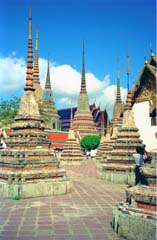
Wat Po (Wat Phra Chetuphon), the Temple of the Reclining Buddha, was built by Rama I in the 16th century and is the oldest and largest Buddhist temple in Bangkok. The compound, divided into two sections by Chetuphon Road, is a 15-minute walk south of the Grand Palace entrance. The northern area contains the most important monuments, and the southern portion is where resident monks live.
Most people go straight to the enormous Reclining Buddha in the northern section. It’s more than 140 feet long and 50 feet high, and was built during the mid-19th-century reign of Rama III. The statue is brick, covered with layers of plaster, and always-flaking gold leaf; the feet are inlaid with mother-of-pearl illustrations of 108 auspicious laksanas (characteristics) of the Buddha.
Wat Saket (The Golden Mount)
Ratchadamnoen Klang and Boripihat Roads
open 9am-5pm
Admission to the Wat is free;
admission to the chedi, separate small donation
Wat Saket is easily recognized by its golden chedi on top of a hill near the pier for Bangkok’s east-west Klong ferry. The wat was restored by King Rama I, and 30,000 bodies were brought here during a plague in the reign of Rama II. The hill, which is over 200 feet high, is an artificial construction begun during the reign of Rama III. Rama IV brought in 1,000 teak logs to shore it up because it was sinking into the swampy ground. Rama V built the golden chedi to house a relic of Buddha, said to be from India or Nepal, given to him by the British. The concrete walls were added during World War II to keep the structure from collapsing.
Wat Suthat and The Giant Swing
Sao Chingcha Sq., near the intersection of Bamrung Muang Rd. and Ti Thong Rd. 02/222-0280
Daily 9am-5pm
donation requested.
This temple is among the oldest and largest in Bangkok. It was begun by Rama I and finished by Rama III. Rama II carved the panels for the wihaan’s doors. It houses the beautiful 14th-century Phra Buddha Shakyamuni, a Buddha image that was brought from Sukhothai, and the ashes of King Rama VIII, Ananda Mahidol, brother of the current king, are contained in its base. The wall paintings for which it is known were done during Rama III’s reign.
Wat Traimit (The Golden Buddha)
Traimit Rd., West of Hua Lampong Station, just west of the intersection of Krung Kasem and Rama IV Roads
Daily 9am-5pm
Walk southwest on Traimit Rd. and look for a school on the right with a playground.
The wat is up a flight of stairs overlooking the school
Donation requested
Wat Traimit, which is thought to date from the 13th century, is known for its astonishing Buddha, which is nearly 10 feet high, weighs over 5 tons, and is believed to be cast of solid gold. It was discovered by accident in 1957 when an old stucco Buddha was being moved from a storeroom by a crane, which dropped it and shattered the plaster shell, revealing the shining gold beneath. This powerful image has such a bright, reflective surface that its edges seem to disappear, and it is truly dazzling. The graceful seated statue is thought to have been cast during the Sukhothai period and later covered with plaster to hide it from the Burmese or other invaders. Pieces of the stucco are on display in a case to the left.
Vimanmek Mansion Museum
193/2 Ratchavitee Rd. Dusit Palace grounds 02/281-8166
Daily 9:30am-4pm
Classical Thai dance, folk dance, and martial art demonstrations are given daily at 10:30am and 2pm.
Opposite the Dusit Zoo, north of the National Assembly Building
Admission charged; free if you already have a 125B ticket to the Grand Palace and Wat Phra Kaeo
Built in 1901 by King Chulalongkorn the Great (Rama V) as the Celestial Residence, this elegant, golden teakwood mansion was restored in 1982 for Bangkok’s bicentennial and reopened by Queen Sirikit as a private museum with a collection of the royal family’s memorabilia. An intriguing and informative hour-long tour takes you through a series of apartments and rooms (81 in all) in what is said to be the largest teak building in the world. The original Abhisek Dusit Throne Hall houses a display of Thai handicrafts, and nine other buildings north of the mansion display photographs, clocks, fabrics, royal carriages, and other regalia.
Wang Suan Pakkard (Palace of the Lettuce Garden)
352 Si Ayutthaya Rd.
02/245-4934
Open daily 9am-4pm
Transportation: Between Phyathai and Ratchaprarop Rds
Admission includes material for a self-guided tour of grounds and collections
Wang Suan Pakkard is one of Bangkok’s most delightful retreats. This peaceful oasis was the home of Princess Chumbhot of Nakhon Sawan. Five 19th-century teak houses were moved from Chiang Mai in 1952 and rebuilt in a beautifully landscaped garden on a private klong, separated by a high wall from the tumult of Bangkok’s streets. The Lacquer Pavilion (actually an Ayutthaya house, moved here in 1958) was a birthday present from the prince to the princess.
Nightlife:
CM2, Novotel
Soi 6, Siam Square.
Resembles a theme park more than a nightclub, with various entertainment zones, including Club La Femme, sporting suggestively padded walls, for women only. Admission price depends on the night’s eentertainment.
Deeper
Soi 4, Silom Road.
Long-running hardcore dance club, decorated to give an underground look. Free, except Fri & Sat cover includes one drink.
Peppermint
Patpong 1
Chart-sound dance club, popular with travellers and Thais. No cover. moderate drink prices.
Rome Club
90-96 Soi 4, Silom Road.
Once the city’s leading gay nightclub, now one of its most fashionable mixed venues (except gay night on Thurs). Drag show every midnight, good sounds and sound system, and a large dance floor. Cover includes one drink.
Taurus
Soi 26, Sukhumvit Road.
Well-designed place, which encompasses on its various levels a balconied disco with plenty of room to dance, eateries and a pub with live bands; dress up. Cover.
Themes for Thai dance drama are taken from the Ramayana. A series of controlled gestures uses eye contact, ankle and neck movements, and hands and fingers to convey the stories’ drama. It is accompanied by a woodwind called the piphat, which sounds like an oboe, and percussion instruments.
Chalernkrung Royal Theatre
66 New Rd., 02/222-0434
A troupe of 170 dancers now performs the Khon Masked Dance, with stunning light effects and high-tech sophistication. English translations are printed in the programs and on screens above the stage. Performances are held Tuesday and Thursday at 8 PM. Your hotel can make seat reservations.
Various restaurants offer a classical dance show with dinner.
Baan Thai (Soi 22, Sukhumvit Rd. 02/258-5403) is a popular one for those staying at hotels in the eastern part of Bangkok.
The Sala Rim Naam
Oriental Hotel, 489 Charoen Nakom Rd
02/437-6211
Show and buffet of Thai food.
National Theatre
Na Phra That Rd.,
PHONE: 02/221-5861 or 02/224-1342,
Performances are given most days at 10 AM and 3 PM, and special performances are held also on the last Friday of each month at 5:30 PM.
Dinner Cruises:
These two-hour evening cruises on the Chao Phraya River are strictly for tourists, except the one run by Yok Yor (Wisutikasat Rd. at Yok Yor Pier (next to Bank of Thailand, 02/281-1829 or 02/282-7385 which is likely to be all Thai. Boats like the Wan Foh 02/433-5453 built to look like a traditional Thai house. Cruise starts at the Mae-Nam Building near the Shangri-La Hotel. A Western/Thai dinner is served .Your hotel staff will make reservations.
The Horizon
Shangri-La Hotel
02/236-7777
departs at 7:30 PM
Also offers a cruise on the river while serving its guests dinner.
Sightseeing Tours
Numerous tours cover Bangkok and the suburbs. With slight variations, they cover the following itineraries.
Floating Market Tour:
This half-day tour is a boat ride on the Chao Phraya and into the klongs (small canals), to the former site of a lively floating market. Most of the vendors who sold vegetables, fruit, meat, and other products from their sampans have long since disappeared, and the remaining vendors are believed to be subsidized by the tour operators. Recommended, instead, is a tour to the floating market at Damnoen Saduak.
Grand Palace and Emerald Buddha Tour:
Because you can easily reach the palace by yourself and hire a guide on the spot, you may want to visit these sights independently.
City and Temples Tour:
In half a day, you can visit some of Bangkok’s most famous temples: Wat Po with the reclining Buddha; Wat Benjamabopit, famous for its marble structure; and Wat Traimitr, with the five-ton golden Buddha. Again, this can be done independently.
The Chao Phraya Express Company
operates a system of ferries that run up and down the river, stopping at the many piers (tha in Thai) on both sides of the river . Cross-river ferries carry passengers back and forth across the river from almost every express-boat pier, though often from a separate landing. Most tourists will board the express boats near the Oriental Hotel, at the pier just south of the hotel, or at the Tha Siphya Pier, just south of the Royal Orchid Sheraton. (02/222-5330)
Day Trips from Bangkok:
Samut Prakan Crocodile Farm
The compound is open daily from 7.00 a.m.-6.00 p.m.
This large farm with over 60,000 fresh and saltwater crocodiles is some 30 kilometers from Bangkok. Daily shows featuring crocodiles are staged at hourly intervals. There is also a Dinosaur Museum where various species of life-size creatures of dinosaurs and their skeletons are on display.
Ancient City
Km 33 on Sukhumvit Highway
open daily from 8.00 a.m.-5.00 p.m.
The Ancient City’s office in town also organizes day tour to the museum.
Contact (02) 2241057, 2261936 for further information.
Essentially an open-air museum, this more than 200-acre complex contains scale replicas of religious complexes, monuments and buildings found throughout Thailand.
Nakhon Pathom Thai Human Imagery Museum
Located at Km.31 on Borom Ratchonnani Road on the way to Nakhon Pathom,
The museum is open from 9.00 a.m. – 5.30 p.m.
The museum houses life-sized fiberglass sculptures of former monarchs, ecclesiastics and rural folk, created by a group of Thai artists after 10 years of their intensive study and hard work.
Rose Garden Country Resort
32 kilometers west of Bangkok on Phetkasem Road.
The resort is open daily from 8.00 a.m.-6.00 p.m.
It boasts large, beautiful, and well-maintained gardens. In the resort, there is a Thai Cultural Village where an attractive show commences daily. Thai folk dancing, Thai boxing, sword fighting demonstrations, and an elephant show.
Samphran Elephant Ground & Zoo
Located just one kilometer from the Rose Garden
open daily from 8.00 a.m. – 5.30 p.m.
This 60 acre farm is another interesting attraction housing many different wild animals and thousands of crocodiles. Fascinating performances such as crocodile wresting, magic show, and elephant theme show everyday.
Ratchaburi
Damnoen Saduak Floating Market
This popular floating market is located some 80 kilometers southwest of Bangkok via Samut Songkhram province, accessible by regular bus from the Southern Bus Terminal. Everyday hundreds of vendor boats crowd the market area in the early morning till noon. Visitors can also travel around by boat to see local villages, and local way of life in the countryside.
Ayutthaya Bang Pa-In Summer Palace Visitors can take either a bus or a train from Bangkok to the palace. The ground is open everyday from 8.00 a.m.- 4.00 p.m.
The palace is about 1 hour drive from Bangkok. Built in the reign of King Rama V, the palace consists of various styled buildings. Thai, chinese, Italian, and Victorian styles predominate. A Thai pavilion in the center of the small lake is regarded as one of the finest examples of Thai architecture.
Bang Sai’s Royal Folk Arts and Crafts Center
The compound is open daily (except Mondays) from 8.30 a.m.- 4.00 p.m.
Farmers from Ayutthaya as well as from other rural areas undergo training in folk arts and crafts here. Visitors can have a glimpse of how farmers in different regions of Thailand live and work, and how their products of art and craft are produced. These handicrafts including weaving basketry, carving wood, artificial flowers, hand-woven silk and cotton, and miniature Thai dolls are on display and on sale.
Nonthaburi
Ko Kret
Take the express boat to Pak Kret in Nonthaburi. From Pakkret pier take a short walk to Wat Sanam Nua where a river ferry leaves for Ko Kret regularly from 6.00 am-9.00pm.
This is a tiny island in the Chao Phraya River, not far from Pak Kret District Office. It is inhabited by a community of craftmen famous for their distinctive style of pottery which dates back many centuries. Ko Kret pots are known for their fine, red-black glazed surface and intricate design. The islanders are the descendants of the Mon people, and they have managed to retain the skills of their forefathers.
Boats:
Express boats are long white boats with a pointed bow and a large number near the front. They carry the Chao Phraya Express logo on the side, and have bench seats and open sides. Don’t confuse these with the smaller, cross-river ferries, distinguished by their squatter shape and rounded bow.
Boats pull up and pause for just a moment, so boarding passengers must move quickly. Fares are based on distance. The onboard ticket taker will ask your destination and charge accordingly for the trip.. To exit, move to the back of the boat and be ready to hop off. As on any public conveyance in Bangkok, keep a close hold on your belongings. Both express boats and ferries operate daily between 6am and 6pm, with boats arriving every 10 minutes or so.
Long-tail boats–slender, noisy, motorized gondolas–provide ferrylike transportation through the inland klongs on the Thonburi side, leaving when full from the Tha Ratchawong, Tha Thien, Tha Chang, and Tha Maharaj piers. Allow an hour to ride on one, just to see the fascinating neighborhoods across the river. The fare should be 5B to 10B (15¢ to 25¢). Get off at any stop and take another boat back.

Dusit Zoo
Rama V and Ratchawithi rds.
02/-0000
Daily 8am-6pm
Admission charged
The Dusit (also called Khao Din) Zoo is in a lovely park between the Chitralada Royal Palace and the National Assembly. Besides admiring the many indigenous Asian animals (including royal white elephants), you can rent paddleboats on the pond. Children can ride the elephants while their parents rest and snack at one of the zoo’s cafés under broad shade trees.
Adventureland
Seacon Square
904 Sri Nakarin Rd
Regular bus #133 from Sukhumvit Soi 77.
Mon-Fri 11am-9pm, Sat & Sun 10am-10pm; free entry
Rollercoasters, go-karts, a “simulator” cinema and a rollerblade rink.
Dream World
Nakhon Nayok Road,
ten minutes’ drive north of Don Muang Airport
Regular buses #39 and #59 from Rajdamnoen Klang in Banglamphu to Rangsit, then songthaew or tuk-tuk to Dream World.
Mon-Fri 10am-5pm, Sat & Sun 10am-7pm
Admission charged
Theme park with different areas such as Fantasy Land, Dream Garden and Adventure Land. Water rides and other amusements.
Magic Land
72 Phaholyothin Rd, about 2km north of Chatuchak Weekend Market, near Central Plaza Mon-Fri 10am-5.30pm, Sat & Sun 10am-7pm
Air-con buses #2 from Silom Road, #3 and #9 from Rajdamnoen Klang Road in Banglamphu, and #13 from Victory Monument and Sukhumvit Road.
Admission charged.
Disneyland-style theme and amusement park, with fairground rides and water parks.
MBK Magic Land
8th Floor, Mah Boon Krong Shopping Centre
at the Rama I/Phrayathai intersection
Mon-Fri 10.30am-6.30pm, Sat & Sun 10.30am-8pm
Centrally located amusements centre in downtown Bangkok, with indoor fairground rides.
Royal Barges
On Klong Bangkok Noi, north of the Phra Pinklao Bridge, Thonburi
Take a taxi over the Phra Pinklao Bridge or take a ferry to Tha Rot Fai (“Railway Landing”), walk west along the street parallel to and between the tracks and the klong until you come to a bridge over the klong, cross the bridge and follow the wooden walkway.
Open daily 8:30-4:30
Admission charged
These elaborately decorated sailing vessels, the largest over 50 yards long and rowed by up to 60 men, are used by the royal family on state occasions or for high religious ceremonies These splendid ceremonial barges, carved in the early part of this century, take the form of mythical creatures of the Ramayana. Most impressive is the red-and-gold royal flag barge, Suphannahongse (Golden Swan), carved from a single piece of teak and used by the king on special occasions.
Red Cross Snake Farm
1871 Rama IV Rd.
At the corner of Rama IV Rd. and Henry Dunant
02/-0161
Daily 8:30am-4:30pm
Admission charged.
For a short, entertaining, and enlightening show, stop by the Thai Red Cross Snake Farm (the Queen Saovabha Memorial Institute) in the heart of Bangkok opposite the Montien Ho Established in 1923, the farm was the second facility of its type in the world (the first was in Brazil). There are slide shows and snake-handling demonstrations weekdays at 10:30am and 2pm; on weekends and holidays at 10:30am.
You can also watch the handlers work with deadly cobras and equally poisonous banded kraits and green pit vipers. They also demonstrate venom milking. The venom is later gradually injected into horses, which produce antivenom for the treatment of snakebites.
Wat Phra Keo (Temple of the Emerald Buddha)
Grand Palace compound.
Admission charged.
Open daily 8:30-11:30 and 1-3:30.
No building within the Grand Palace compound excites such awe as the adjoining royal chapel, the most sacred temple in the kingdom. This is the most ornate wat in Thailand, embellished with murals, statues, and glittering gold. Inside sits the Emerald Buddha, a venerated image carved from a single piece of jade 31 inches high.
Vimanmek Mansion Museum
193/2 Ratchavitee Rd. Dusit Palace grounds 02/281-8166
Daily 9:30am-4pm
Classical Thai dance, folk dance, and martial art demonstrations are given daily at 10:30am and 2pm.
Opposite the Dusit Zoo, north of the National Assembly Building
Admission charged; free if you already have a 125B ticket to the Grand Palace and Wat Phra Kaeo
Older children will enjoy the Thai dance and martial arts demonstrations. It is suggested that they not be expected to tour the 81 rooms of the mansion. Possibly, there can be a rotation system between parents so that the zoo, the mansion museum, and the demonstrations and dances can all be enjoyed at the level of tolerance and attention span of the children.
Wat Po
Maharat Rd., near the river B 02/222-0933
Daily 8am-5pm; massages offered until 6pm
About a half mile south of the Grand Palace
Donation requested
Wat Po (Wat Phra Chetuphon), the Temple of the Reclining Buddha, was built by Rama I in the 16th century and is the oldest and largest Buddhist temple in Bangkok. The compound, divided into two sections by Chetuphon Road, is a 15-minute walk south of the Grand Palace entrance. The northern area contains the most important monuments, and the southern portion is where resident monks live.
Most people go straight to the enormous Reclining Buddha in the northern section. It’s more than 140 feet long and 50 feet high, and was built during the mid-19th-century reign of Rama III. The statue is brick, covered with layers of plaster, and always-flaking gold leaf; the feet are inlaid with mother-of-pearl illustrations of 108 auspicious laksanas (characteristics) of the Buddha.
Children will enjoy the giant Buddha statue and the surrounding garden which are filled with interesting statues.
Safari World
99 Ramindra Rd
9 kilometers from the city center in Miniburi.
Take bus 26 from the Victory Monument to Miniburi
From there a minibus service runs to the park
Admission charged.
Mon-Sun 9-4:30
170 acre complex with African animals living in the wild. An air conditioned Safari World coach drives visitors through the park to view monkeys, lions, rhinos, giraffes and zebras, plus a sea-life area with dolphins and sea lions.
Siam Water Park
101 Sukhaipbarn 2 Rd.
half an hour east of town.
1 hour by regular bus 26 or 27 from Victory Monument
10-6 Mon-Fri. 9am-7pm Sat, Sun.
Admission charged.
Water world with artificial waves, fountains, waterfalls, and chutes and slides. Also a theme park and botanical garden and midway attractions.
December 5:
On the King’s birthday a parade of the colors is performed in Bangkok by Thailand’s elite Royal Guards.
December 31-January 2:
New Year celebrations are usually at their best around the temples. In Bangkok, special ceremonies at Pramanae Ground include Thai dances.
February:
Magha Puja commemorates the day when 1,250 disciples spontaneously heard Lord Buddha preach the cardinal doctrine on the full moon of the third lunar month.
February-April:
Kite-flying contests are held at the Pramanae Ground in which barbs on the kite strings are used to destroy opponents’ kites.
April 6:
Chakri Day commemorates the enthronement of King Rama I, founder of the present dynasty, in 1782.
Mid-April:
Songkran marks the Thai New Year and is an occasion for setting caged birds and fish free, visiting family, dancing, and water-throwing, in which everyone splashes everyone else in good-natured merriment.
May:
Plowing Ceremony: At the Pramanae Ground, Thailand’s king and queen take part in a traditional ritual that opens the rice-planting season.
May 5:
Coronation Day: The king and queen take part in a procession to the Royal Chapel to preside over ceremonies commemorating their coronation.
May:
Visakha Puja: On the full moon of the sixth lunar month, the nation celebrates the holiest of Buddhist days-commemorating Lord Buddha’s birth, enlightenment, and death. Monks lead the laity in candlelit processions around their temples.
August 12:
Queen Sirikit’s birthday is celebrated with religious ceremonies at Chitlada Palace, and the city is adorned with lights galore.
November:
Held on the full moon of the 12th lunar month, Loi Krathong is the loveliest of Thai festivals. After sunset, people throughout Thailand make their way to a body of water and launch small lotus-shaped banana-leaf floats bearing lighted candles. The aim is to honor the water spirits and wash away one’s sins of the past year.
November:
Golden Mount Festival: Of all the fairs and festivals in Bangkok, this one at the Golden Mount is the most spectacular, with sideshows, food stalls, bazaars, and large crowds of celebrants.
We offer deeply discounted rates for Bangkok travel vacation packages,
airline tickets, hotel rates and car rental services. Build your own trip now
through our travel products:
– Get cheap airline tickets from our “Seat Inventory” source, best price and
seats for your family.
– Find your cheap hotel rates from our “Best Rate Guarantee” at over 300000
global properties.
– Rent a car at the price you want to travel Bangkok. We offer cheapest car
rental service from wide selection of inventory rates
– Best travel deals for our cheap vacation packages or last minute travel
deals. We offer best vacation package rates with deeply discounted prices (up to
70% of regular rates)
– Visit our home page for all travel deals such as:cheap airline tickets, hotel rates, car rental, vacation packages and tourist attractions. Why pay more? save your money now!